Best Brass Nozzle for Ender 3 V2: What Fits and What to Buy
The Ender 3 V2 takes MK8 brass nozzles (M6x1, 5 mm thread, 13 mm long). Which ones to buy, when plated brass pays off, and how to fit one leak-free.
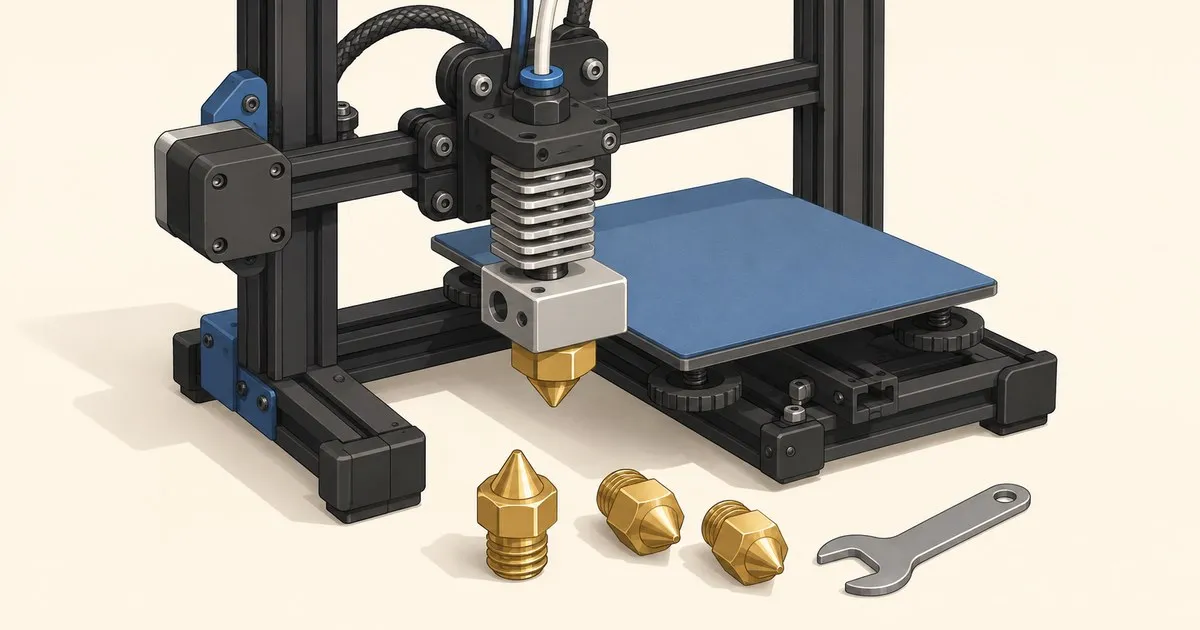
The best brass nozzle for Ender 3 V2 owners is not one magic part number. It is any well-machined MK8 brass nozzle in the right diameter, seated hard against the PTFE liner so it never leaks. The V2 shipped with a 0.4 mm brass MK8 nozzle, so the decision comes down to three questions: plain brass or plated, which diameters, and whether a high-flow core is worth the extra money. Prices and specs below come from the vendors’ own pages.
What physically fits: the MK8 spec
The Ender 3 V2 hotend is an MK8 type fed by a Bowden extruder, per the 3DJake listing for the printer. Bondtech describes the MK8 nozzle standard as M6×1×5×13: an M6 thread with a 1 mm pitch, 5 mm of thread, and 13 mm overall length. Micro Swiss lists the same 5 mm thread and 13 mm length, and the flats take a 6 mm wrench.
The trap is the E3D V6 nozzle. It shares the M6 thread but not the length, and 3DMaker Engineering’s nozzle guide warns that a short MK8 nozzle in a V6 hotend leaves a gap inside the heater block. If a listing says MK8 or names the Ender 3 series, it fits; if it says V6 or Volcano, it does not.
Why brass is still the right default
Prusa’s knowledge base puts it plainly: brass has excellent heat conductivity and is tough enough for most common filaments. Steel conducts heat worse, which is why 3DMaker Engineering says you often need to run 5 to 10 °C hotter with hardened steel for the same flow.
Brass loses only on abrasion, and the numbers are stark. E3D’s own test found that 250 g of carbon-filled filament wrecked a 0.40 mm brass nozzle, while a hardened steel nozzle pushed 2.5 kg with zero observable wear. CNC Kitchen’s wear test adds nuance: 330 g of glow-in-the-dark PLA produced no measurable change in orifice diameter, but 360 g of ColorFabb XT-CF20 wore the tip away, with the first layer creeping upward as the nozzle got shorter. PLA, PETG, ABS and TPU do none of that (the PLA vs PETG vs ABS comparison covers the differences), and brass handles them indefinitely.
The picks, with prices
| Pick | What it is | Price on the vendor page | Best for |
|---|---|---|---|
| Creality MK8 Nozzles Kit, 24 pcs | Plain brass, assorted diameters | $14.99 at the Creality store | Spares and a first 0.6 mm |
| E3D MK8 Brass | Plain brass, 0.25, 0.40, 0.60, 0.80 mm | £11.90 at E3D; $13.06 for 0.4 mm at 3DJake | Consistent bore geometry |
| Micro Swiss MK8 Plated Brass | 360 brass, TwinClad XT coating, 0.2 to 1.0 mm | $14.99 each | PETG, TPU, occasional filled filament |
| Bondtech CHT MK8 | Nickel-coated brass, split-channel core, 0.4 to 1.8 mm | $19.90 at Bondtech | Faster printing at 0.6 mm and up |
Spares and experiments: Creality’s own kit. The 24-piece MK8 kit is $14.99 direct from Creality. The store page does not list the diameter mix, so check the listing photos if you need a specific size count. This is a direct vendor link, not an affiliate one.
Precision plain brass: E3D MK8. E3D machines its MK8 nozzles with the same internal geometry as its V6 and Revo lines, which it says helps avoid high back pressure. They are £11.90 direct, and the 0.4 mm listing is $13.06 at 3DJake. Pick it when bore consistency matters more than quantity.
Plated brass: Micro Swiss. The Micro Swiss MK8 is 360 brass under a TwinClad XT nickel-composite coating that Micro Swiss describes as very low friction and abrasion resistant, at $14.99 per nozzle. The coating is what you want if PETG keeps building a burnt collar on the tip or TPU is gumming up.
High flow: Bondtech CHT MK8. Bondtech’s CHT coated brass nozzle splits the filament into thinner strands so it melts from the inside, and Bondtech claims flow gains of 25 to 65 % depending on hardware and settings. It costs $19.90 direct, and MatterHackers stocks the 0.4 mm. On a stock V2 the Bowden extruder and the PTFE liner cap how much of that gain you can use, so it pays off mainly at 0.6 mm and above.
For diameter, 0.4 mm remains the all-rounder and 0.6 mm the underrated upgrade for functional parts; the nozzle size and layer height guide covers the usable layer-height band for each.
Disclosure: the 3DJake and MatterHackers links fall under this site’s affiliate disclosure. The Creality, E3D, Micro Swiss and Bondtech links are plain vendor links.
The stock hotend’s temperature ceiling
The V2’s Bowden tube runs through the heat break and ends against the back of the nozzle, so PTFE sits inside the heated zone. Capricorn says sustained use of its XS tubing should not exceed 240 °C, with 260 °C survivable only for brief maintenance. That sets the rules for any brass nozzle on a stock V2: PLA at 200 to 215 °C, PETG at 230 to 240 °C, and no chasing the 280 °C hot-tightening figure Bondtech gives for its CHT nozzles. On this hotend, tighten at your normal print temperature.
Fitting it so it never leaks
iFixit’s Ender 3 V2 nozzle guide is the sequence to follow, with one addition at step 5:
- Remove the two 2 mm hex screws holding the fan shroud, then slip off the silicone sock.
- Heat to print temperature, pull the filament, and loosen the old nozzle a quarter turn with the supplied wrench.
- Let the hotend cool fully, then unscrew the nozzle the rest of the way.
- Thread the new nozzle in until it stops, then back it off about one turn.
- Push the Bowden tube down from the top of the hotend until it presses against the nozzle, following the MK8 PTFE-gap procedure, and keep pressure on it while you tighten the nozzle back down.
- Reheat to print temperature and give the nozzle its final snug. Prusa’s service teams use 2.5 N m on brass nozzles; Bondtech caps its CHT at 1.5 N m. Neither needs a torque wrench: firm, not cranked.
Step 5 is the one people skip, and it is why a fresh nozzle can jam on its first print: molten plastic fills the gap between tube and nozzle, hardens, and blocks the path. That gap is also a classic heat-creep trigger, and Creality Reviews covers the symptoms if a new nozzle keeps clogging anyway.
How to verify the swap
- Leak check. Heat to 220 °C, hold for ten minutes with no extrusion, and look for any bead of plastic at the nozzle-to-block seam or the top of the block.
- First layer. Re-set the Z-offset, since a new nozzle rarely sits at the old height. A 0.2 mm first layer should print as fused lines with no ridges.
- Flow. Print a single-wall cube at 0.45 mm line width and measure the wall with calipers. Adjust flow rate until it reads 0.45 mm plus or minus 0.02 mm.
- Temperature and retraction. Run a temperature tower, and if you changed diameter, re-tune retraction with the stringing guide.
Who should skip brass
Anyone feeding carbon-fibre, glass-fibre or metal-filled filament regularly. E3D’s 250 g figure means a single spool of CF-PETG can finish a brass nozzle. Buy hardened steel for those spools, run it 5 to 10 °C hotter, and keep the brass for everything else.
Sources
- Micro Swiss: MK8 Brass Plated Nozzle (TwinClad XT)
- Bondtech: CHT Coated Brass Nozzle for MK8 hot blocks
- E3D: MK8 Brass Nozzles for Creality Ender and CR10
- E3D: Are Abrasives Killing Your Nozzle?
- CNC Kitchen: How much abrasive filaments damage your nozzle
- Prusa Knowledge Base: Different nozzle types
- Prusa Knowledge Base: Changing or replacing the nozzle
- iFixit: Creality Ender 3 V2 Extruder Nozzle Replacement
- MakerMade: Removing the PTFE gap in MK-8 style hot ends
- Creality Store: MK8 Nozzles Kit 24 PCS
Related

Nozzle Size and Layer Height: How to Choose Both Together
Nozzle diameter and layer height are not independent settings, because one constrains the other. How to pick both for detail, strength, or print speed.

3D Printer Calibration Order: What to Tune First
This 3D printer calibration order starts with mechanical checks and bed leveling, then covers e-steps, temperature, flow, pressure advance, and retraction.

Pressure Advance Calibration for Klipper and Marlin
Pressure advance fixes bulged corners and starved line starts. How to calibrate it in Klipper, Marlin Linear Advance and OrcaSlicer, with starting values.